
Q-REstrain (SOT Therapy): What It Is, How It Works, and Who It’s For
A complete guide to gene-targeted therapy for Lyme disease, cancer, and chronic viral infections.
Published by Health & Wellness of Carmel
You saw the post. You typed “SOT.” That means you’re curious — and we’re glad you are. Q-REstrain is one of the most significant therapies we offer at Health & Wellness of Carmel, and it deserves a real explanation. Here’s everything you need to know.
What Is Q-REstrain?
Q-REstrain — formerly known as SOT (Supportive Oligonucleotide Therapy) — is an autologous, gene-targeted therapy developed by RGCC (Research Genetic Cancer Centre Group). It uses a branch of molecular biology called RNA interference (RNAi) to silence the specific genes that keep harmful cells — whether cancer cells, bacteria, or viruses — alive and functioning.
In plain language: your own blood is used to create a custom molecule designed to find your specific pathogen or cancer cells and shut them down at the genetic level. It’s not a drug. It’s not a generic supplement. It’s built from you, for you.
Most treatments manage the disease. Q-REstrain is designed to end it.
How It Works: The Key & Lock
Think of your pathogen — whether it’s Lyme, a virus, or a cancer cell — as having a lock. A very specific lock. Q-REstrain works by creating a molecular key that fits that lock exactly, binding to the gene responsible for its survival and switching it off.
1
Your blood is drawn (15–30ml) and sent to the RGCC laboratory in a specialized vial.
2
The lab identifies the specific gene sequence responsible for your target’s survival — the “lock.”
3
The target is validated computationally and in the lab to confirm the molecule won’t interfere with anything else in your body.
4
Complementary oligonucleotide molecules (microRNAs) are synthesized — the “keys” — freeze-dried, and shipped back to our clinic.
5
It’s administered intravenously in a single office visit, then works 24 hours a day for up to 6 months.
Once infused, the molecule circulates through your body continuously, binding to the target gene and inhibiting the proteins essential for the pathogen’s or cancer cell’s survival. It also crosses the blood-brain barrier — something many antibiotics and conventional treatments cannot do.
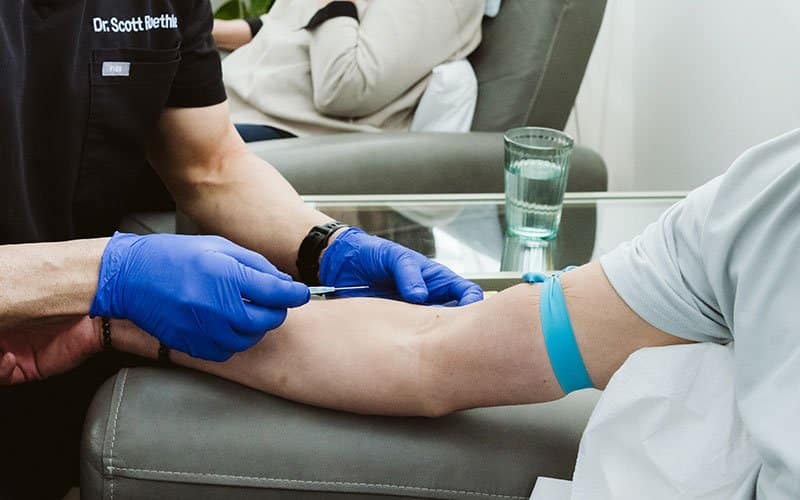
Blood draw for Q-REstrain — 15–30ml is all that’s needed to create your personalized therapy.
Who Is Q-REstrain For?
CANCER
Q-REstrain can be used for patients with solid tumors or hematological malignancies, regardless of disease stage. It is designed to work alongside conventional treatments and does not interfere with most other therapies when properly timed. Patients must be at least 11 years old; CNS (brain) cancers are not currently eligible.
LYME DISEASE & CO-INFECTIONS
For patients with chronic Lyme who have cycled through antibiotics without full resolution, Q-REstrain offers a fundamentally different approach — not suppression, but gene-level silencing. It targets a wide range of Lyme-related pathogens including:
- Borrelia (19 species)
- Babesia (6 species)
- Rickettsia rickettsia
- Bartonella (6 species)
- Anaplasma phagocytophilum
- Ehrlichia chaffeensis
VIRAL INFECTIONS
Q-REstrain can target many common and persistent viruses including:
- Herpes simplex (HSV)
- Varicella-zoster (VZV)
- Hepatitis B & C (HBV/HCV)
- Coxsackie virus
- Epstein-Barr (EBV)
- Human papillomavirus (HPV)
- HIV
- And others
The Clinical Data
2022 CLINICAL OUTCOMES
95%
of Lyme, Bartonella & Babesia patients had a positive clinical outcome
91%
of viral infection patients had a positive clinical outcome
78%
of cancer patients had a positive clinical outcome (complete, partial, or stable disease)
What to Expect
BEFORE YOUR INFUSION
To ensure accurate targeting, you’ll need to pause certain therapies before your blood draw — typically 14 days for Lyme/viral, 14–21 days for cancer patients. This includes antibiotics, antivirals, IV vitamin C, and ozone therapy. You’ll also need positive lab confirmation of your target pathogen within the past 6 months.
THE INFUSION
Done right here at our clinic. You’ll receive a saline IV line, pre-medications (dexamethasone is standard; famotidine and acetaminophen are typically included), then the Q-REstrain itself as a slow IV push. You’re monitored for 45–60 minutes, then free to go.
AFTER THE INFUSION
Most patients resume normal activities the same day. Mild fatigue, headache, or flu-like symptoms can occur — often a sign the therapy is working. Routine supplements (multivitamins, vitamin D, probiotics, glutathione, binders) continue without interruption. Most other therapies resume within 7–14 days.
HOW OFTEN?
Cancer: Up to 4 infusions per year, spaced at least 3 months apart.
Lyme & Viral: Up to 9 infusions per year, spaced at least 21 days apart.
Is Q-REstrain Right for You?
MAY BE ELIGIBLE
✔️ Chronic Lyme not resolved by antibiotics
✔️ Persistent EBV, HBV, HCV, or other viral loads
✔️ Cancer (solid tumor or hematological)
✔️ Confirmed pathogen on recent lab testing
✔️ Age 5+ for Lyme/viral; 11+ for cancer
NOT CURRENTLY ELIGIBLE
✖️ CNS (brain) cancers
✖️ Pregnancy or breastfeeding
✖️ Recent blood transfusion (120-day wait)
✖️ Recent cytotoxic chemotherapy
✖️ Gamma Delta T Cell Therapy
✖️ Children under 5 (Lyme/viral)
Could Q-REstrain be part of your healing path?
The first step is a consultation at Health & Wellness of Carmel. We’ll review your labs, history, and current treatment plan together.
Visit hwofc.com to Learn More
Recent Post
 Q-REstrain (SOT Therapy): What It Is, How It Works, and Who It’s For
 Lyme Disease: What You Need To Know
 Vitamins for Cancer Fatigue
 Holistic Cancer Care: How Naturopathic Centers Support Healing
 How is Lyme Disease Contracted and is It Treatable?
 How Effective is Using IV Therapy as an Anti-Inflammatory?